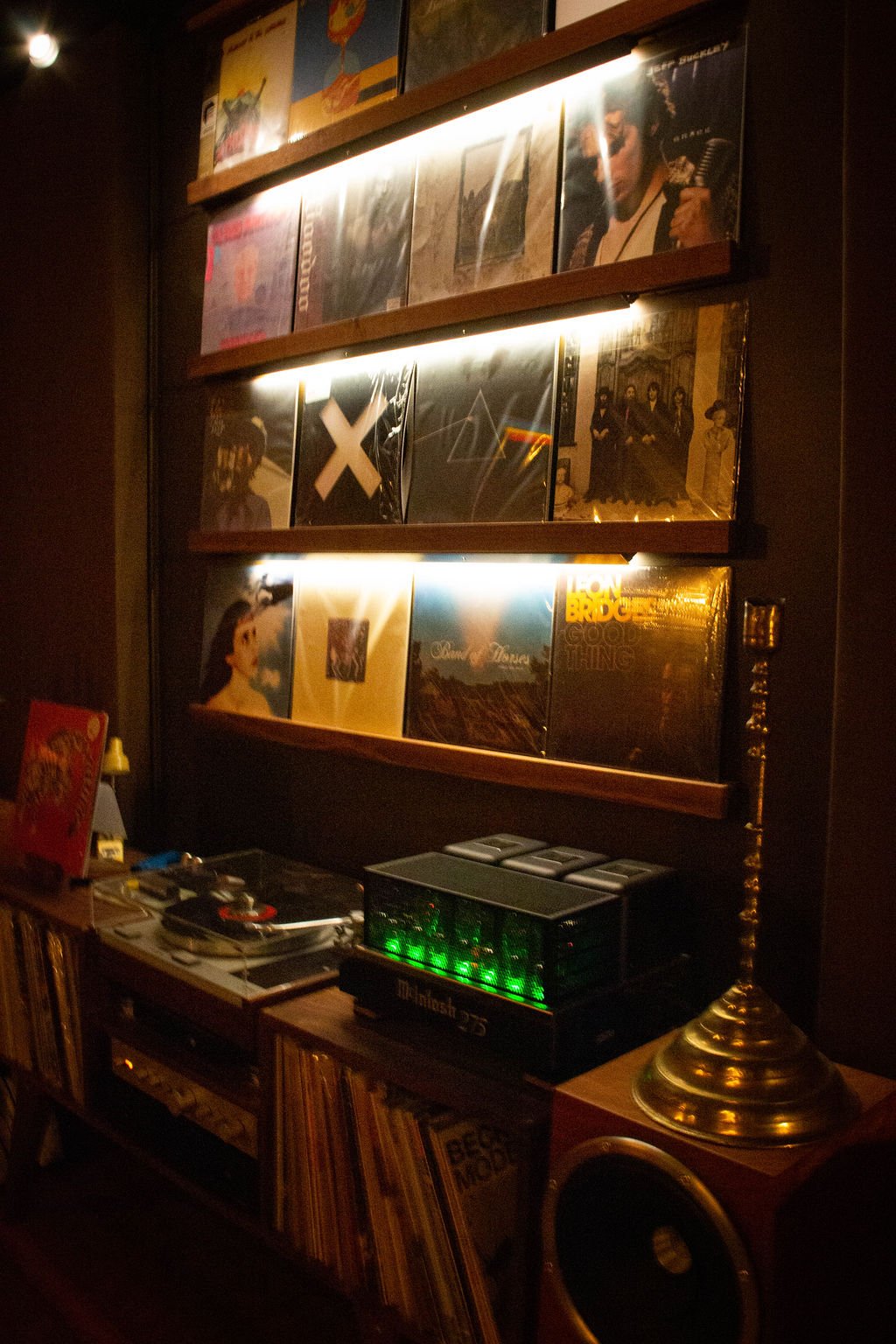
Most sessions at B-Side have a moment. The room settles, needle drops, and somewhere during the first side a stillness takes over. Nobody planned it. Nobody announces it. Twenty people who mostly do not know each other are suddenly listening as one.
We built the room for that moment. A book I just read gives us better language for what it is.
What is Awe?
Dacher Keltner is a psychologist at UC Berkeley who has spent his career studying emotion. In Awe: The New Science of Everyday Wonder and How It Can Transform Your Life, he defines awe as, “the feeling of being in the presence of something vast that transcends your current understanding of the world.”
Vast does not have to mean big. It can be a mountain range or a night sky. It can also be an idea, an act of courage, or a piece of music that holds more than you can take in at once. What matters is that it exceeds the frame you walked in with, and you have to make room for it.
Awe is not the same as happiness or excitement. It tends to make the self (ego) feel smaller and the world feel larger. People describe chills, tears, a catch in their breath, a sense of being part of something bigger. Keltner found that people around the world locate awe in a handful of places: nature, moral beauty, collective movement, spiritual practice, art, and music. In Keltner’s book, music gets its own chapter and it’s subtitle says a lot about why B-Side exists: How Musical Awe Embraces Us in Community.

A full album, heard start to finish without interruption, is long enough for that other kind of understanding to arrive. Sometimes it brings an answer. More often it brings a feeling.
Music says what language cannot
Keltner leans on the philosopher Susanne Langer, who argued that the purpose of art is to give feeling a form. When we make music, we archive what Langer called "the pattern of life." Keltner defines life patterns as, “the great themes every person eventually meets.” Such as: What it means to suffer. To lose. To love. To protest unfairness. To be overpowered by forces larger than yourself. To encounter mystery. To live and to die.”
Then I read a part that stopped me. Keltner, drawing on Langer, puts it this way: our spoken word "is typically held to standards of truth, or veracity." It moves forward "in a linear sense of time." That is the language of our working lives. The inbox, the meeting, the to-do list.
Music is freed from all of that. It follows “different laws of space, time, and causality.” In that realm, Keltner writes, "fast, holistic intuitions arise about life patterns, or possible truths about our lives." Langer concluded that the meaning we find in art has "no counterpart in any vocabulary." Music, in her words, "is a tonal analogue of emotive life."
Keltner tells the story of Yumi Kendall, a cellist with the Philadelphia Orchestra, playing Mozart's Requiem the week her grandfather died. She had not cried at his death. In the middle of the performance, the tears came, along with memories of singing the same piece in high school and a sense that her grandparents were there with her. By the end she felt calm, sad, and at peace. It wasn’t a conversation that had taken her there. It was the music.
This is the case for a room like B-Side. We spend our days inside linear, literal language. We rarely get a dedicated hour where something else is allowed to do the talking. A full album, heard start to finish without interruption, is long enough for that other kind of understanding to arrive. Sometimes it brings an answer. More often it brings a feeling.

You do not need to understand what a song is about to understand “what it is about.” Your body already knows.
The sound itself carries the meaning
So how does music hand us these life patterns? Keltner admits the easy answer is lyrics. In his research across twenty-six cultures, people wrote about specific words that changed how they saw their lives. You can probably name a line that did that for you.
But he points to a more complex possibility. The sounds of music, apart from any words, stir specific emotions on their own. The Swiss emotion scientist Klaus Scherer spent forty years working out how.
His idea is simple once you hear it. Every emotion changes the body. Breathing, heart rate, and muscle tension all shift, and those shifts change the sound of our voice. Anxiety tightens the throat and produces high, flat, rapid sounds. Musicians, Scherer argues, express emotion by making sounds that resemble those vocal patterns. Pitch, rhythm, contour, loudness, and timbre carry the feeling.
Keltner and his colleague Alan Cowen tested this with wordless music. People in the United States and China shared short pieces they felt expressed different emotions. New listeners in both countries could reliably pick out thirteen emotions, including in music from a culture they had never heard. Awe was one of them. The music that expressed awe had acoustics resembling the whoas, wows, and aahs we make when we feel it.
Maybe, this is why we care so much about how a record sounds in our room. If the meaning lives in pitch, contour, and timbre, then the texture of the sound is not decoration. It is the message. A horn on a jazz record can tell you about grief without a single word. A record heard on a carefully built system, in a quiet room, at a volume where you can feel the low end, gives that message every chance to arrive intact.
It is also why we listen to whole albums, and why an instrumental record can move a room as deeply as anything with words. You do not need to understand what a song is about to understand “what it is about.” Your body already knows.
What you carry back down the stairs
When strangers tap to the same beat, they show more compassion and more willingness to help one another. Music that gives us chills “inclines us to trust and share more with a stranger.”
B-Side is a good fun night out. We hope it always is. But Keltner's chapter makes the case that musical awe does real work in people's lives, that may extend, long after the record ends.
It changes the body. Slow, melodic music lowers heart rate and blood pressure, a sign the vagus nerve is calming us down. Music that moves us activates the brain's reward circuitry, which opens the mind to wonder and exploration. The chills and tears are the physical signs of that shift.
It clears the head. Charles Darwin timed his daily walks to hear the choir at King's College Chapel. The writer Rachel Carson listened to Beethoven when she was stuck, and described the moment she suddenly understood what her book needed to be. People in Keltner's research described music bringing them clarity and a sense of their place in the larger scheme of life.
Maybe my favorite learning: it binds us to each other. When people listen to the same music together, their brains begin to synchronize. In one study, the more a listener's brain synced with the group, the closer they felt to the people around them. Music, Keltner writes, "breaks down the boundaries between self and other." When strangers tap to the same beat, they show more compassion and more willingness to help one another. Music that gives us chills “inclines us to trust and share more with a stranger.”
Read that last part again. Then Imagine, twenty strangers in a room, sharing the same album, at the same quiet moment. That is not a side effect of what we do at B-Side.
The Greeks had a word for it: communitas, the sense of social harmony that comes when the rhythms of separate lives fall into one pattern. Keltner closes that idea with a line we may borrow for the rest of our lives. "Music surrounds us in a cashmere blanket of sound."
That is what we are building in Provo, with you. A third place where you step out of the linear, literal pace of the week and let something larger do the talking. You leave a little calmer. A little clearer. A little more open to the person sitting next to you. Then you take that back into your work, your family, and your town.
Our Town.
Come sit with us. Bring a friend, or come alone and leave with one.
Source: Dacher Keltner, Awe: The New Science of Everyday Wonder and How It Can Transform Your Life (Penguin Press, 2023), Chapter Seven, "Musical Awe."
All photos by Ed Resto & Jordan Dorrance @familialcollectivemedia